Legal
and Political Info
International
Gay and Lesbian
Human
Rights Commission
International
Lesbian and Gay
Association
Amnesty
International
Country
Information
Moroccan
Embassy in
Washington,
DC
Morocco
Info
Moroccan
Cities
Independent
Travel
Explore
Morocco
Guidebooks
Lonely
Planet Guide to Morocco
Spartacus
Gay Guide
Gay
Guides on the Net
Gay
Info Exchange
Lonely
Planet Thorn Tree
Gay
Morocco
Gay
Morocco Cybersurf
Gay
Times-Morocco
Gay
Guide
Al
Fatiha
Intnl LGB Org.
Gay
Scene FAQs
Gay
Morocco News & Reports
Morocco
Photo Gallery
Gay
Islam Reports 1998-2002
Gay
Islam Reports 2003-05
Gay
Islam Reports 2006
Arab
Gays & Lesbians
GLAS
Society
Gay
Egypt.com
Gay
Arab.org
Queer
Jihad
Sehakia
Arab Women
GayArab.com
Pan-African LGBT web site: Behind the mask
Newspapers/Magazines
Morocco
Daily
Gay
Muslim Magazine
Huriyah
Magazine
HIV
in Morocco
Aegis
Literature
About
Morocco/Gay/Sexuality
Gender
and Romance
Adolescence
Influence
of Media
Queer
Studies
Sex
in Middle East Societies
'Sexuality
and Eroticism among Males
in Moslem Societies'
by Arno Schmitt and
Jehoda Sofer (1992)
'The
Native Informant'
by Ramzi Salti
'Opening
the Gates'
by Ramzi Salti
'Sexuality
and Islam'
by Abdelwahab Bouhdiba
Stephen O. Murray and Will Roscoe, Islamic Homosexualities: Culture,
History and Literature (New York and London: New York University
Press, 1997).
Paul & Jane
Bowles
Authorized
Bowles Website
Interview
Documentary
Video
Out
in the World: Selected Letters of Jane Bowles, 1935-1970
Other LGBT Travel Links
Lesbigay Travel Info/ News
Rex Wochner Lesbigay News
Gay Reading (webzine)
365Gay.com (webzine)
Gay.com/Planet Out.com News
Gay Today.com
Gay Wired (news/scene/trave/)
Advocate Magazine
Gay and Lesbian Review
Our World Magazine
Out and About Travel Letter (USA)
Out Traveler Magazine
QT Travel Magazine
Gay Travel News
Gay Travel Site
Venturing Out Travel Stories
Passport Magazine
The Grey Gay Guide
Gay Places
Gay Travel Plus
BootsnAll Resources
Queery.com
Fridae.com
Lesbian.com
LGBT Travel Writers
Jan Morris (The Grande Dame)
Jan Morris (BBC Bio)
Martinforeman.com
Peter Tatchell (Activist & Writer)
Bruce Chatwin
Sasha Alyson
LGBT Travel Books (Essays/Stories)
Wonderlands
Lesbian Travels
Gay Travels
Travelers' Journals (mixed)
TravelPod.com
(New LGBT Forum)
Worldsurface.com
Lonely Planet Thorn Tree
Lesbigay Travel Tours
Intnl. G/L Travel Association
Bluway Gay Travel
David Tours
Hans Ebensten Deluxe Tours
RSVP Vacations
Damron Guides and Travel
Gay Travel Plus
Gay.com/Planet Out Travel
Utopia Tours (Asia)
Alyson Adventures
Friends Travel
Gay Away
Venture Out
bGay Travel
Orbitz G/L Travel
Now Voyager
Innovative Gay Travel
Above and Beyond Tours
Pride Holidays
Gay Jet
Purple Roofs Travel
Gay Crawler
Hermes Tours
Gay Family Vacations (with kids)
Olivia Cruises & Resorts
R Family Vacations
Camp Lavender Hill
Camp It Up
Rainbow Family Camp
Worldwide Gay Life,
Sites and Insights Gay
Morocco--Myths
and Realities Also see:
Dedication (March 2004) This
story is dedicated to the memory of my friend George Waldo (right)
who contributed
much to the making of this report. An educator,
writer, film and theatre critic who divided his time between London,
El Jadida
in Morocco and California, George was a gentleman of learning, compassion
and a playful wit. Anyone he befriended became better for it
out of his wisdom and guidance. He
lovingly mentored and helped educate several young Moroccan friends
over the course of his dozen years in El Jadida. George
was murdered in December 2003 in his home by a young assailant who
knew him. More
details can be read in the Moroccan
News and Reports page
of this site.
By Richard
Ammon
Realities in the Streets Real Morocco begins on the beehive streets of such cities as Meknes and Rabat with cafes brewing espresso or mint tea next to souks (markets) spilling out handcrafts and plastic bowls. At every turn are hawkers pushing cheap carpets, costumed water sellers rattling tin cups, crowded commuter buses and school kids skipping off to school in their blue and white uniforms. Here, young men and women mix casually and easily in public. Many women wear robes and veils, and many more go about their business in western skirts, jeans and pants. A breezy public freedom for both genders is found here more than in other stricter Muslim countries. Morocco, to a casual outsider, appears a cheerful place to wake up in the morning. It appears both familiar and exotic. These relative
freedoms, however, don't alter the masculine tenor of this culture. There are no women driving cars or steering those infamous Mercedes
taxis that pack in eight people. No women are to be seen in the countless
coffee bars along the crooked streets of Meknes. Only leathery males
sitting with their muddy coffee or tea staring at TV soccer match. Men
also attend to the pint-sized shops packed closely together in the souks,
whether it's a barber shop, tobacco shop or butcher shop. Men are the
merchants and women (married with kids) are busy at home with food and
shelter. Hidden Realities
Among premarital men, male-to-male intimacy is a common, temporary, convenient and secretive form of sexual contact. This bonding is a sort of masculine rite of passage from puberty to manhood. However such intimacy does not identify them, to themselves or each other, as 'homosexual'. This ambiguity wrapped in paradox is an informal matter for Moroccans and an enigma for uninformed western visitors. The best way to understand it, as an outsider, is to see visit the streets of Morocco and let the experience happen. And then do some thoughful reading.
Our first encounter with Moroccan eros took the form of a young man no more than 15 who spotted us we drove into Moulay Idriss, a hilltop town on the way to ancient Volubilis in north central Morocco. At first this aggressive sprite offered to be our guide to Moulay but we declined (not an easy task). We parked and walked through the narrow alleys up to the peak where we could see across the entire valley considered sacred by native Muslims. As we finished, the kid reappeared insisting he could show us a 'special' view of the city. We again declined and got into the car. I was seated with my elbow out of the window when he pressed his crotch against my arm, not slightly but deliberately and more than once as he insistently tried to bargain with us--and in clear view of his peers hanging around the parking lot. It happened quite quickly as we were pulling out of our place. As gay men, we were caught off guard as to how to respond in this public situation. We took these antics lightheartedly yet not without a little surprise. But this was hardly the time to ask the guy what he wanted or meant. So we were left with this playful puzzle as we drove away to the ruins of Volubilis.
North of Moulay Idriss, set in rolling fields of wheat, Volubilis was once a beautiful Roman town. Masterful mosaic floors and Corinthian columns still attest to the prosperity and elegance of this most westerly of all Roman cities. Once this was a thriving town of thousands making their daily way along smooth walkways to public baths, granaries, gardens, public forum and the basilica.
There is perhaps no more poignant impact for a sentient visitor than the silence that prevails over history with its once-noisy commerce, political drama and bloody wars. The day was a lesson in contrasts: past and present, history and the living moment stone carved memorials and youthful eros. It was a good introduction to the real and the mythic Morocco.
Reflecting on the kid, it was easily evident that he was coming on to us and using his adolescent sexuality to manipulate us. But as strangers in a strange land we weren't sure what was real or what was pretended. From what we had read and heard, we doubted he was gay or that he intended to have a 'homosexual' experience. In this culture he certainly wouldn't have shown that in public since homosexual acts are a punishable crime (6 months to 3 years imprisonment). He was probably indifferent to the sexual behavior itself. Rather, to this impoverished and unemployed guy, we were foreign objects of desire with endowed wallets in our trousers. We would find out more in El Jadida a week later when we visited an American friend who lived in Morocco.
Later that evening, I checked e-mail at the shiny Sheraton Hotel in the new town. A swarthy dark haired staff member was pleased to help me get online while gently pressing his leg against mine as we focused (sort of) on the monitor. Gaydar wanted to signal contact, but this was more likely his usual manner of camaraderie with other guys. Men touching each other in public here doesn't carry the same suspicious overtones that condition us in the west. Returning to our hotel room after an hour of (non-sexual) e-mail sorting, which overlooked the town of Fez, the key to our room would not work so we asked one of the bellboys for help. As it happened the handsome man named Jose spoke Spanish and some French so we chatted for a few minutes before he left. Twenty minutes later there was a knock on the door. It was Jose, quite friendly, easy going and eager to continue with our multilingual chat. It didn't take long to read his face and body language to understand that he was sizing us up for a possible 'interlude'.
All of this came together a few days later when we arrived to take in the coastal sights of the ancient and modern port of El Jadida. For ten years this charming and bustling town has been home for our friend George Waldo , an expat gay Californian. Educated at Columbia University and USC, he is a sprightly, intelligent gay man not appearing to be in his early sixties. He delights in his penchant for swarthy younger men, happily admitting that such attractions led him to north Africa (first Algeria, now Morocco) where he has been a teacher, writer and drama critic (frequently flying to major European cities to see plays and concerts). We checked into our hotel at his suggestion since a gay friend of his owned the place. That evening we were surrounded by the soft ambience of the hotel's dining room and well satisfied by the menu du jour (fish filet with vegetables and rice). Dinner conversation wrapped around his experiences and insights about 'gay' life in Morocco, which helped clarify our own impressions and experiences of Moroccan sexuality so far.
George explained that unmarried Moroccan men form tight friendships with one another, which may or may not include sexual activity. Commonly, the younger man of the two assumes the female role for anal or interfemoral contact. When the older friend eventually marries, the younger boy becomes the older one and takes his turn in the dominant role both as leader and sexual partner.
George explained that many foreign gay men do visit or live in Morocco because of the relative ease in procuring men for paid sex. For most short-term visitors, that's often the purpose of the trip--which results in a distorted understanding of Moroccan male sexuality. We told George about our encounter with the boys in Moulay and Fez. He agreed that these seductive gestures were not based on attraction but rather the cash payoff. "It's likely the kid in Moulay was schooled (and probably screwed) by the older boys and learned to use his immature prowess to seduce westerners--especially a pair of guys." He went on to say, "at 13 or 15, these kids already know how to cock-tease, how to bait foreigners and do sex in return for dollars. It's sad, and it's only because they're so poor!" We agreed, as we came to see in Morocco, that poverty speaks louder than propriety, discretion or self-respect.
But sex is not always the prominent force between natives and foreign gays. Tender and caring relationships form as well. George has known first hand about the role of 'mentor' as a valued and accepted tradition. It is a delicate role that has to be cultivated over time. As a foreigner seeking more enduring contact, he has learned to be gentle and patient in order to develop the trust that's necessary between him and a native apprentice. It's not unusual for a young Moroccan to be playful but it's quite another matter to become seriously involved with an older foreigner who wants more than sex, even if the native guy is really gay.
The matrix of Moroccan sexuality is such that George cannot ever be sure what the future of any relationship will bring, but not just because a younger 'partner' may be heterosexual. There is risk even with falling in love with a self-acknowledged homosexual young man: "most of these guys get married in order not to disobey or offend their parents and families. You see, matrimony is the most important tradition in the life of any young Moroccan. Families love weddings; for many, they are the highlights of a dreary working class life." In past generations, to shun this norm has carried a social stigma. Increasingly however, modern urban men (and fewer women) feel more freedom to live a lifestyle that pleases them without feeling forced to please others.
Still, most gay Moroccans never have an ongoing gay relationship. Mostly, they are married with kids and find only an occasional assignation for their secret needs. There are exceptions to this, of course, as we found out, since one such man was standing nearby--our hotel owner, Ali, a quietly charming man of about 50. His current ownership of the hotel was the result of a relationship with his late partner who passed away a couple of years ago. They had been lovers for thirty years even though Ali was married for twenty of those thirty years and the father of two children.
Ali told us that he cared very much for his family, but when George asked if he loved his wife, Ali looked away for a second before he replied: " I love her as I am suppose to. (Pause) As long as I do my duty to her, financially and sexually, I am free to have my life outside the home. She does not ask questions." I could see from this bifurcated answer that even after all these years, this middle-aged gay Moroccan had not fully reconciled his inner nature with the social demands on him. I appreciated, however, the sincerity and devotion he had divided, as fairly as he could, among his significant others.
The next day we went with George to his beach house on the coast. Safi Bouzid is a resort town south of El Jadida with long flat stretches of white sand along the Atlantic. A tiled promenade runs for about a kilometer along the beach dotted with cafes and snack shops for viewing the sea. It's informal and relaxing. Our calm and restful afternoon was pleasantly interrupted by the antics of an adolescent horsing around on the water's edge with his companion. As they laughed and splashed, I noticed he frequently looked in our direction. Eventually the friend wandered off leaving this guy on his own to show off with jogging in place, push ups and knee squats, working his way closer to our cafe as he bounced around. It became evident that he had gotten himself excited from these exercises and he was intent on letting us see the expansion under his not-so-baggy shorts. I pointed him out to George who was busy with his newspaper. He looked up and laughed as if to say 'of course, what did you expect?'
A minute later, realizing he had lost them as customers for that service, the guy came up and started chatting, asking them to let him show them around the city. George said it was both laughable and poignant. "What a bizarre hierarchy of offerings: sex, city guide, and finally begging for cigarette money. When we refused all his suggestions, he disappeared." It was a sad and awkward occasion, George said. For the guy, success with any of these offers would have resulted in some badly needed income. Poverty vexes both askers and refusers. As for our little beach acrobat, after a while of antics and strutting his best stuff, he realized his western admirers were not responding. So he packed up his towel and walked into the distant sand and sun. Turning for a last glimpse he waved, and I waved back. The gesture reminded me of Tadzio's final wave to Aschenbach in the film 'Death in Venice'--just before Aschenbach succumbed to the deadly strawberries!
By now, after a couple of weeks in Morocco we had come to expect cruisy behavior from street guys who used the slightest opportunity to hit on us. We were walking targets and these swarthy kids were not stupid. It was easy to see we were foreign men together without women. We were green flags that sent out vibes that we had money, and sex was their only way to snare us. Once we were aware of this frame, the titillation and playfulness became dulled. Being viewed as an object for sex and money is alienating and irritating. I imagined this is how many of them feel toward leering western queens. George understood what I was talking about and said he had learned to see past that attitude and look for sincere people. "They all start by looking, so you look back but you don't play their game. You just keep walking. Or sometimes, if I have time, I walk up to one of them and start talking. They don't expect this. You call their bluff and often they skitter away or lose interest; a lot of them have nothing to say or can't speak English so the encounter is dead in the water. I just walk off and forget it. Otherwise you get sucked into their sexy lies. It's not real and I have more important things to do."
Another piece of this psychosexual matrix is that many young men here crave admiration. They are alone in their private sorrow for their fathers who take the advantage of the culture and don't spend a lot of time with them. Teaching their sons about affection and intimacy at home is not comon. Indeed, along the boulevards of Moroccan towns are countless evening cafes full of middle-aged men hovering or arguing over coffee or tea while bracing a cigarette between two fingers. In this emotional vacuum, the attentions of older western men, especially sincere and generous ones like George, are welcomed and are reciprocated with a certain amount of loyalty. Over his years in Morocco, George has had long term affairs in which he fostered the affections and welfare of several Moroccans.
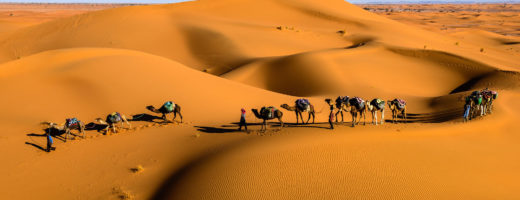
But Morocco is not all about hormones and ambiguous romance. There is much history and beauty to this northwest corner of Africa. A week later we arrived at the Auberge Merzouga in the Sahara Desert. There are rooms as well as tents for rent. We opted for one of the black wool Berber tents only fifty yards from dunes. From a short distance, the hostel looked like a medieval fort with small turrets and foot-thick walls of white plaster. The tent was $3.50 and dinner was $5-- tagine lamb and vegetable stew and harine soup--delicious and savory.
The night passed under a billion crystal stars spread out across the sky like scattered fairy dust. There are not more stars here, just less human produce to murk up the sky. We were the only guests that night. Absolute silence and darkness prevailed on the edge of the great timeless desert. In places like this, it's best to go out, look up at infinity, say nothing and think less for a while. At 5 AM, from the earthen village of Merzouga half a mile away the muezzin called out his chant in the blackness, "Allaho-akbar...", to those who might come and pray for the first of six times daily. The chant was too sweet to call an interruption. Mostly, at that hour, only the roosters responded to the muezzin's cry.
In the morning, the urge to climb the dunes was too seductive and we submitted. The powdery surface was difficult to walk on so I settled for a lesser mound that presented me with an impressive photogenic view of the rising light and falling shadows. I sat for a while on this warm soft mustard hill running my hands in the sand and lifting up a handful to watch the fine grains running through my fingers. I imagined this is what infinity must feel like as I watch the earth slip away from my grasp back into the countless other grains surrounding me. Footprints left today are gone in an hour. The desert is a good place to contemplate immortality and the passing of time. Thoughts or beliefs make not one grain of difference among the sand mountains that have drifted here for a million years. It's not sad or joyous, just quiet and endless. For two wondrous weeks, we had found in Morocco a land of history, sublime night skies, moderate Muslim life and a few hormones.
No gay American should visit Morocco without some knowledge of the expat writer and composer Paul Bowles who lived most of his life in Morocco. This quintessential outsider died in 1999 at the age of 88. He was one of the central figures in what was called the 'pre-lost Generation' who befriended such icons of 20th century art as Aaron Copeland, Christopher Isherwood, Gertrude and Alice, Orson Welles, and Tennessee Williams among others including such iconoclastic figures as Alan Ginsberg. His most famous work was the novel 'Sheltering Sky', which was eventually made into a movie.
In tribute to his life, a full-page obituary appeared in the New York Times of November 19, 1999. The reporter wrote: "In his strange, exotic life, Mr. Bowles apparently did exactly what he wanted to do, writing fiction and music and continually searching for that magic place where he would find his twined goals of wisdom and ecstasy."
PS: A
reader recently (March 06) sent this comments to GlobalGayz.com: |