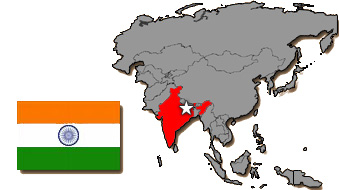
India, Asia


India is the seventh-largest country by geographical area, the second-most populous country, and the largest democracy in the world. It has the world's twelfth largest economy at market exchange rates and the fourth largest in purchasing power. Economic reforms have transformed it into the second fastest growing large economy; however, it still suffers from high levels of poverty.

Homosexuality in India is generally considered a taboo subject by both Indian civil society and the government. Scholars differ in their views of the position of homosexuality within India's main religious traditions. There have been arguments that homosexuality was both prevalent and accepted in ancient Hindu society. Since 2001 a major legal challenge was mounted against Section 377 of the Indian Penal Code that criminalised homosexuality. The Delhi High Court ruled in favor of decriminalisation on 2nd July 2009. This ruling had the effect of making homosexuality legal across India. However many religious and fundamentalist groups have challenged the judgement in the Supreme Court, and a final judgement from the Supreme Court is pending as of 2011.  Also see: Islam and Homosexuality


Related GlobalGayz Articles & Photos:

India’s Gay Attorney in High Court: Interview With Aditya Bondyopadhyay

| January 24th, 2012 | Comments Off

By Lisa Out & Around: Stories from a Not-So-Straight Journey Jan 04, 2012 In 2009 in a landmark case, the Delhi High Court challenged the constitutionality of India’s anti-sodomy law, Section 377. The results have catapulted India into a stronger gay rights movement. Out & Around met with Aditya Bondyopadhyay (photo right), a leading attorney on the legal team that constructed the case. Aditya now spends most of his time training attorneys across India on LGBT rights. Out & Around: Tell us about your work leading up to the decriminalization of homosexuality in 2009. Aditya: I worked on the case beginning in 2001. The case became a focus of mobilization for LGBT activists. Earlier, people were doing their own things due to geography in this country being so vast. What the case really did was unite groups across India by way of a national movement. We had a common enemy,

See the Full Version Here

Gay Leader Ashok Row Kavi Interview with Out & Around

| January 24th, 2012 | Comments Off

By Lisa Out & Around: Stories From a Not-So-Straight Journey Jan 09, 2012 In a bursting country of billion people, it’s rare to be known as the “first” to do anything. Yet, journalist Ashok Row Kavi (photo right) is well-known in India for being the first gay person to come out publicly in the country. His first coming out interview was in 1986 with Savvy Magazine, an Indian feminist magazine, explaining what “gay” really meant. With his background in journalism, he founded Bombay Dost, India’s first gay magazine in 1990. In 1994, Ashok went on to establish the Humsafar Trust, a large sexual health NGO in India which focuses on HIV and LGBT rights. We caught up with Ashok in Delhi to talk about gay life in India… Out & Around: What is unique about India? Ashok: Everybody looks at India like a country, a nation. I think this is

See the Full Version Here

An Open Letter to the Health Minister of India Mr Ghulam Nabi Azad

| July 24th, 2011 | Comments Off
Gay Bombay logo

By Vivek Divan Gay Bombay Group Dear Mr Ghulam Nabi Azad, Health Minister of India It appears you need a dose of enlightenment since your recent statements on homosexuality smack of either ignorance, misinformation or rank prejudice. I hope that this missive serves that purpose, although I am doubtful. On the other hand, I hope that it shames you. I know what shame is like, having lived most of my life in a world that never understood a core part of me — my sexuality. For your irresponsibility you deserve no part in the governance of a nation that prides itself on tolerance and diversity. Your bosses should dismiss you immediately, but I have a feeling they won’t. It is hard to imagine that you are the health minister of India. I imagine that responsibility entails in its very essence promoting the well-being of all Indians. And not consigning some

See the Full Version Here

The Bible is Propaganda–Bring Me Science

| July 10th, 2011 | Comments Off

Ya gotta love the old guy who said this: “We should not accept religious literature instead of scientific report.” The Delhi High Court bench headed by Chief Justice A P Shah remarked in response to a Solicitor General who cited an article condemning gay sex by quoting the Bible. “These are not scientific reports. These are articles quoting Bible which is a propaganda. Your arguments should be based on scientific reports. Show us scientific reports which justify criminalisation of such acts (gay sex),” the Times of India quoted the Bench. If only other national courts and legislatures would listen to such wisdom we would have societies dominated more by humanistic values than by religious bigotry and irrational political opinions. Carry on Chief Justice A P Shah! And may your words be heard around this troubled gay-hating world. Human development cannot progress forward with one foot stuck in gross ignorance, fear

See the Full Version Here

Love Among the Ruins: USA, an Indian Prince, Love & HIV

| November 4th, 2009 | 2 Comments »

Richard Ammon GlobalGayz.com November 4, 2009 Sydney, Australia While America was limping from the loss of two important marriage-rights elections (New Jersey and Maine), across the globe in India there was a cause for celebration of sorts. Prince Manvendra Gohil, the famous ‘gay Prince’ from Rajpipla state in the western Gujarat area of India announced last night to an audience in Sydney that he had found his “soul mate”. Addressing a forum sponsored by ACON, Australia’s largest community-based LGBT health and HIV/AIDS organization. During the two-hour conference, Manvendra answered many questions to put him from Andy Quan of ACON and from an attentive audience about his personal life and his HIV charity work in his home state. Some questions focused on his history as the only royal personage to come out as gay, in 2005, and his subsequent rejection and acceptance by his family, the media and the people in

See the Full Version Here

A Princely Gay Man – Manvendra Singh Gohil of India Comes Out

| October 29th, 2009 | Comments Off

October 29, 2009 Richard Ammon,  GlobalGayz.com No question that rank carries privilege and privilege carries fame. This time it belongs to an Indian prince who came out as gay in 2005 and shocked his family and fascinated the Indian public. Prince Manvendra Singh Gohil of the Rajpipla region in the state of Gujarat, the westernmost state in India (Mahatma Gandhi was also born in Gujarat) decided he could no longer live the heterosexual life his family expected. After a marriage debacle Gohil announced his homosexuality and was immediately disowned by his royal family. Not a shrinking flower, Gohil publicized his ‘coming out’ on the Oprah show in 2007 and proved to be a charming, articulate and intelligent spokesman for gay authenticity and gay rights. Since then he has traveled the world speaking out against discrimination. Instead of withdrawing behind gilded walls and silken pillows he has taken on charitable projects

See the Full Version Here

Leading Spiritual Teacher in India Discusses Being Gay as it Applies to Spirituality

| July 26th, 2009 | Comments Off

Copenhagen, Denmark – July 26, 2009 Richard Ammon, GlobalGayz.com Many years ago, I attended a couple of seminars offered by this “guru” when he was little known. Today he is one of India‘s most respected spiritual teachers, and I came across an article about what he recently said about being gay. So much has been written about homosexuality since the Delhi High Court judgment to strike down Section 377, which the British imposed on the Indian legal system in 1861. Here is what Sri Sri Ravi Shankar had to say in a recent interview on the subject.   Question: The new Pontificate (Vatican) is expected to take a rigid stance on issues like those of gay relationships. What do ancient scriptures say about these matter? Guruji: As far as the ancient scripture is concerned, there is neither mention nor prohibition of it. One thing the ancient scriptures say, as far

See the Full Version Here

Homosexuality not a Taboo in Jharkhand Tribe (India)

| July 18th, 2009 | Comments Off

Westhampton, MA – July 18, 2009 Richard Ammon, GlobalGayz.com Well, here is some fine news, for a change, from the July 6, 2009 Hindustan Times, that is not full of oppression, homophobia, anti-gay sermons or discriminatory political statutes. Turns out that “among the Ho tribe of Jharkhand (a state in Eastern India ) homosexuality has always been socially accepted. Homosexual men are called Kothi Panthis in the region. There is no shame attached to being one.” And it’s obviously known around that these men folks get conjugal with each other to the point where a survey was done about their behavior. An NGO called Citizens Foundation studied a 20 km area and indeed found that Chaibasa town has a higher incidence of homosexual activity. (Compared to what other finding? I wonder if the donors to Citizens realize their funds are used to study the consensual sexual behavior of adult men,

See the Full Version Here

High Court Decriminalizes Homosexuality, July 2009

| July 4th, 2009 | Comments Off

An Historic Event After 150 Years of Injustice and Discrimination: Delhi High Court Strikes Down Law Against Homosexuality Intro: There come moments in the life of a nation when it has to confront its deepest prejudices and fears in the mirror of its constitutional morality. The Delhi high court’s decision legalizing consensual homosexual acts does just that. The judgment is a powerful example of judicial craftsmanship. It embodies the right combination of technical rigour in thinking about the law, with a persuasive vision of the deepest values those laws embody. Presented here are four separate stories from four different perspectives: Part 1: Social Implications Part 2: Personal Reactions Part 3: Religious Reactions Part 4: Legal Issues Part 1: Social Implications By Pratap Bhanu Mehta The writer is president of the Centre for Policy Research, Delhi express@expressindia.com There come moments in the life of a nation when it has to confront

See the Full Version Here

Gay India 2006–Part 1 (Intro): Bombay/Mumbai

| January 1st, 2009 | Comments Off

A four-part journey through south India by Richard Ammon, GlobalGayz January 2007 Also see: Islam and Homosexuality Gay India Stories Gay India News & Reports 2000 to present Gay India Photo Galleries Introduction The sheer size of India makes ‘a’ Gay India story an impossible task, and it’s not just size that matters; it’s also the intense complexity and patchwork of overlapping and diverse religions, discrete language dialects, gender divisions, class prescriptions and prohibitions, political fragmentation and fluid definitions of sexuality. More than a few observers have said that India is a paradox: whatever can be said aloud deeper truths are unspoken; what is seen is unknown; it is packed with life, it is fraught with death; it surges with technology, it travels by ox cart. The same can be said about homosexuality: there is no scene and there is an extensive network; there is no gay life and there

See the Full Version Here

Gay India 2006–Part 2: Hyderabad

| January 1st, 2009 | Comments Off

A four-part journey through south India by Richard Ammon, GlobalGayz December 2006 Also see: Islam and Homosexuality Gay India Stories Gay India News & Reports 2000 to present Gay India Photo Galleries Hyderabad Hyderabad is the capital city of the state of Andhar Pradesh in central India. Over the past decade it has seen exponential growth in its hi-tech sector. There is a Hi-Tech City suburb, dubbed Cyberabad, where sleek modern buildings rise up many floors to house the research and industry of the future. Located here are many tech-help call-centers for American and European manufacturers such as Apple, HP and GE—this is one of the main cradles where ‘outsourcing’ was born. Unborn is a visible LGBT ‘community’. Despite a large population of over 5 million people there is not a single overt LGBT group or organization. As in Bombay and Bangalore a visitor learns not to look for rainbow

See the Full Version Here

Gay India 2006–Part 3: Chennai /Madras

| January 1st, 2009 | Comments Off

A four-part journey through south India by Richard Ammon, GlobalGayz January 2007 Also see: Islam and Homosexuality Gay India Stories Gay India News & Reports 2000 to present Gay India Photo Galleries Chennai (Madras) Sahodaran and SAATHII It’s no easier to find a publicly visible gay community in Chennai than Hyderabad but by scratching the surface (through Gay Bombay Yahoo Group) a visitor can discover there is much more queer life and energy in Chennai. Further guided by the wisdom and advice of Ashok Row Kavi with his extensive contacts I found another well-known leader, Sunil Menon, a USA university educated anthropologist, fashion show designer and director of the award-winning NGO Sahodaran in Chennai. Sahodaran is essentially a health education outreach organization to the underclass and underserved community of male sex workers (MSWs) and wherever possible to their MSM and female customers in Chennai. Sahodaran also has an office in

See the Full Version Here

Gay India 2006–Part 4: Bangalore

| January 1st, 2009 | Comments Off

A four-part journey through south India by Richard Ammon, GlobalGayz January 2007 Also see: Islam and Homosexuality Gay India Stories Gay India News & Reports 2000 to present Gay India Photo Galleries Bangalore Bangalore is another of India’s forward-leaning mega-cities. In the center of the country and at an altitude of 3000 feet it bakes less than Delhi or Calcutta (Kolkota). The weather was quite pleasant (ignoring the pollution) in late November when we arrived by train from Mysore. (A note about land travel: during our trip we traveled by motor-rickshaw, taxi, bus, van, train and plane—no ox cart. Trucks crowding each other off road Early in our planning we thought about renting a car and driving ourselves around the country; this was highly discouraged and we found out why. There are few road signs (fewer in English), many roads are pot-holed or under repair and, most of all, Indian

See the Full Version Here

India – Bombay (photos)

| January 1st, 2009 | Comments Off

Mumbai is formerly Bombay and is the capital of the Indian state of Maharashtra. With an estimated population of thirteen million, it is the second most populous city in the world. Maharashtra is the one of the most urbanized states in India, contributing to 15% of the country’s industrial output and 13.2% of its GDP in year 2005-06. Read the stories about gay India

See the Full Version Here

India – Bombay – Humsafar (photos)

| January 1st, 2009 | Comments Off

Humsafar Trust is the premier health education and sexuality rights organization in India. They offer services and outreach to thousands of people. These photos are of the drop-in center in Mumbai. The Humsafar drop-in center, inaugurated in November 1995, has a long history and has played host to several Mumbaikars from college students to Page Three socialites "coming out". To many it’s a second home as it’s a safe space where one can wear his sexuality on his sleeve and be himself and not being discriminated. The Drop in center is tastefully decorated, with beautiful posters of safer sex messages, television, music system, home theatre system and workshops conducted every week for the community. Read the stories about gay India.

See the Full Version Here

India – Bangalore (photos)

| January 1st, 2009 | Comments Off

Bangalore, with 6 million people, is another of India’s high tech progressive ‘success’ stories with its blend of old poverty and new earned wealth. It is the capital of the Indian state of Karnataka. It’s a crowded place with an elegant capital building, traffic jams, famous cafes and trendy shops. It is also home to one of India’s most vocal human rights organizations, Sangama. Read the stories about gay India

See the Full Version Here

India – Chennai – Madras (1) (photos)

| January 1st, 2009 | Comments Off

Chennai is a major city of over six million, India’s 4th largest metropolis. It has its share of propserous new-age companies and flashy structures. In this gallery are some historic venues such as the Fort St. George built by the British East India Company in 1653, now the administrative headquarters for the legislative assembly of Tamil Nadu state. Enclosed in the area is St. Mary’s church with carved gravestones in the floor. The red-brick High Court is a marvel of Indo-Sarcenic architecture build in 1892. It houses 47 courtrooms attended by several thousand registered lawyers. Along the sea coast on the Bay of Bengal are a huge shipping port, long sandy beaches and a dramatic memorial to the famous independence leader Perarignar Anna. For Christians, Chennai is also a place of pilgrimage as the alleged burial place of the apostle St. Thomas marked by a white gothic basilica built above

See the Full Version Here

India – Chennai – Madras (2) (photos)

| January 1st, 2009 | Comments Off

Chennai is a major city of over six million, India’s 4th largest metropolis. It has its share of prosperous new-age companies and flashy structures. Tucked into the myriad of crowded streets and dense alleys are occasional leafy cafes such as Amethyst Cafe/Boutique that offer fine food and quality merchandise for middle and upper class customers. Read the stories about gay India

See the Full Version Here

India – Goa-Baga-Calangute (photos)

| January 1st, 2009 | Comments Off

Two of India’s most popular beaches for locals and foreigners are Baga and Calangute beaches that offer miles of white beaches, many hotels and restaurants. On these lovely beaches, Goans and tourists spend summers, bathing in or walking along the sea. Most people enjoy the sun and sand fully clothed. Baga is a small but perfect beach located between two more famous towns, Colva on one side and Calangute on the other. It is a far better place to enjoy some restful moments if you don’t like the hustle and bustle of Colva or Calangute. Just north of Calangute is the pretty Sinquerim beach with its five-star resorts. Read the stories about gay India

See the Full Version Here

India – Hyderabad (photos)

| January 1st, 2009 | Comments Off

Hyderabad is one of India’s major cities (almost 6 million people) that has prospered with the coming of the information technology age. It’s a major outsourced call center in the country. One of it’s suburbs is called High Tech City with numerous slick high-rise office buildings. Built around a large lake called Hussain Sagar it offers a mix of ancient forts and monuments, Raj style high court and new age architecture. Read the stories about gay India

See the Full Version Here

India – Hampi (photos)

| January 1st, 2009 | Comments Off

Hampi was once the capital city of a Hindu Vijayanagar empire in the 15-16th centuries. The vast area of temples and shrines, markets and roads covers 43 square kilometers. Hampi is located within the ruins of Vijayanagara, the former capital of the Vijayanagara empire. Possibly predating the city of Vijayanagara, this village continues to be an important religious centre, housing the Virupaksha Temple. The village of Hampi contains several other monuments belonging to the old city. Read the stories about gay India

See the Full Version Here

India – Vijayawada-Pondicherry-Trichy (photos)

| January 1st, 2009 | Comments Off

Vijayawada and Pondicherry and  Tiruchirappalli in southeast India offer places of history, spirituality and commerce, as well as colorful friendly people. Just outside Pondicherry is the international city of Auroville–started in 1968–intended as a place of "human unity". At the center of the commune is the huge round meditation globe known as the Matrimandir, pictured here. Auroville is intended as a place "where all human beings of goodwill…could live freely as citizens of the world…" Read the stories about gay India

See the Full Version Here

India – Kanyakumari (Cape Comorin) (photos)

| January 1st, 2009 | Comments Off

At the southernmost tip of India is the city of Kanyakumari with its variety of sites including a busy fishing port, a mahatma  Gandhi memorial, extensive bazaars, pilgrimage temples and offshore monuments to the spiritual guru Vivekananda and the Tamil poet Thiruvalluvar. Read the stories about gay India

See the Full Version Here

India – Kochi/Cochin (photos)

| January 1st, 2009 | Comments Off

Kochi is an appealing delight for visitors and natives with its high-rise modern buildings on one side (Ernakulam) of its large shipping port and many historic charming European-style buildings and markets on the other in the Mattancherry colonial district. The old European buildings and ambiance attract many tourists. Vasco da Gama was originally buried here in St Francis church (India’s oldest church). Read the stories about gay India

See the Full Version Here

India – Goa-Palolem Beach (photos)

| January 1st, 2009 | Comments Off

Palolem beach in southern Goa offers a respite from the heat and congestion of southern India. The beach is largely unspoiled and is inhabited by both local fishermen and by foreign tourists who live in shacks along the shore. It is about one mile (2km) long and is crescent-shaped. One can view the whole beach from either end. Both ends of the beach consist of rocks jutting out into the sea. The depth of the sea increases gradually, it being shallowest at the northern ends of the beach, making it safe for average swimmers, and the currents are not fast. Read the stories about gay India

See the Full Version Here
Page 1 of 212»