
Compiled by Richard Ammon GlobalGayz.com February 2012 Introduction The good news is that both male and female homosexual acts are legal in tiny Guinea-Bissau on Africa’s west coast. The bad news is that this is Africa where homophobia runs high. Homosexuality in Guinea-Bissau In December 2008, Guinea-Bissau was one of 66 nations to sign a
Following Guinea-Bissau independence in 1974 local black soldiers that fought along with the Portuguese Army against the PAIGC guerrillas were slaughtered by the thousands. Many were executed and buried in unmarked collective graves. The country was controlled by a revolutionary council until 1984. The first multi-party elections were held in 1994, but an army uprising in 1998 led to the president’s ousting and the Guinea-Bissau Civil War. Elections were held again in 2000 and Kumba Ialá was elected president. In September 2003, a coup took place in which the military arrested Ialá on the charge of being “unable to solve the problems.” After being delayed several times, legislative elections were held in March 2004 . A mutiny of military factions in October 2004 resulted in the death of the head of the armed forces, and caused widespread unrest. Elected president in 2005, João Bernardo Vieira Vieira was assassinated in March 2, 2009.
Despite the political violence, both male and female homosexual acts are legal in Guinea-Bissau, although transgender rights are not known. In December 2008, Guinea-Bissau was one of 66 nations to sign a declaration at the United Nations supporting decriminalization of homosexuality and transgender identity. (Information from ILGA World Survey of Laws Regarding Homosexuality 2009.
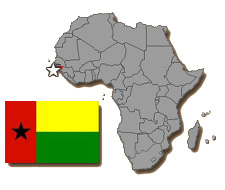
Name: Guinea-Bissau
Population: 1590000
Capital: Bissau - Pop. 408000
Area: 36544 sq. km/ sq. miles
Language: Portuguese, Crioulo
Religion: Muslim
Status of Homosexuality: Legal
Telephone Country Code: 245